Skip to content


A refrigerator that copes fine with a normal week can struggle once it holds a thawing turkey, three pies, a tray of sides and a few cases of drinks. The trouble usually isn’t space alone. A packed fridge blocks the vents that move cold air around, and every trip to the door lets warm air in. Before the guests arrive, make room, confirm the temperature with a thermometer, and plan how you’ll handle leftovers.
Quick Answer
Before holiday hosting, set the refrigerator to 40°F or below and the freezer to 0°F, confirm both with an appliance thermometer, and clear space so air can circulate around the vents. Thaw a turkey on a tray on the bottom shelf, move drinks to a cooler to cut door openings, and refrigerate leftovers within two hours of serving.
Start With a Thermometer, Not the Dial
The numbers on a temperature dial are settings, not measurements. Put an inexpensive appliance thermometer on a middle shelf and another in the freezer, then check them after a few hours. The U.S. Department of Agriculture’s food safety guidance puts the refrigerator at 40°F or below and the freezer at 0°F. If the fridge reads warmer than 40°F while it’s still mostly empty, it will only get worse once you load it, and that’s worth sorting out now.
Make Room Before You Shop
Most refrigerators have at least one vent on the back wall or ceiling of the compartment, and food pushed against it chokes the airflow. Clear out what you don’t need: old condiments, half-empty jars, takeout containers you were never going to finish. Then plan where the big items will go.
- Keep a few inches of open space around the air vents.
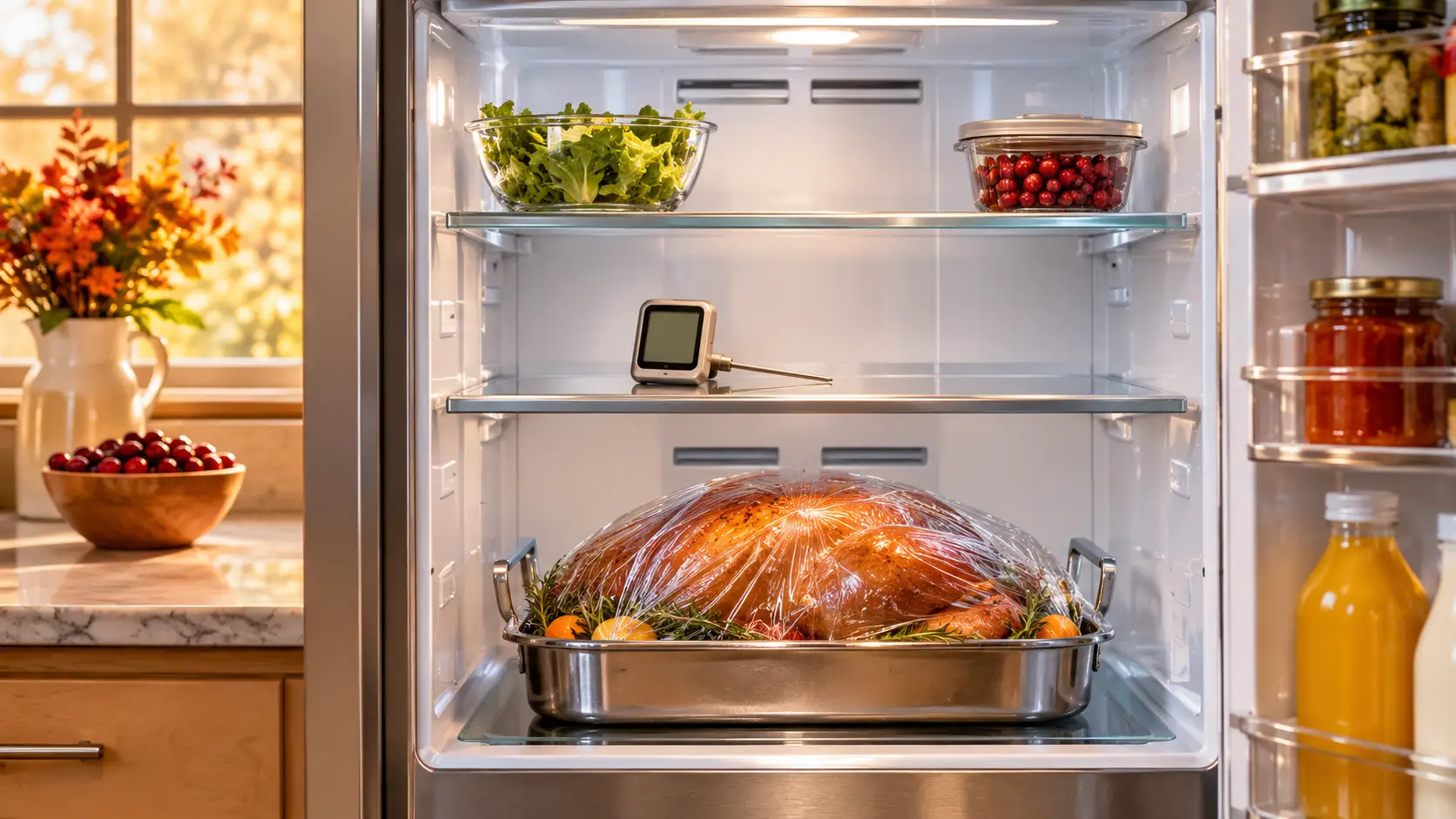
- Put the heaviest, most perishable items, like the turkey, on the lower shelves.
- Move drinks to a cooler with ice. Every time someone opens the door for a soda, the compressor has to work to recover.
- Leave the door shelves for items that tolerate temperature swings, such as condiments and drinks.
Thawing a Turkey in the Fridge
Thawing is where many kitchens run short on time. USDA guidance for refrigerator thawing is about 24 hours for every 4 to 5 pounds of turkey. That means a 20-pound bird needs somewhere between four and five days, so count backward from the holiday rather than starting the night before.
Put the turkey in a rimmed pan or a large tray on the bottom shelf. Thawing poultry can drip, and you don’t want that landing on produce or leftovers below. If the fridge is too full for a whole bird, a cold-water thaw is an alternative, but it needs more attention, and you should read the USDA’s instructions for it before you try.
Handling Leftovers Without Overloading the Fridge
Food shouldn’t sit at room temperature for more than two hours, or one hour if the room is above 90°F. That’s USDA guidance, and it’s a good reason to clear the table sooner than feels polite.
Hot food can go straight into the refrigerator. Divide it into shallow containers so it cools quickly, instead of leaving it in the big roasting pan, which can stay warm in the middle for hours. Don’t stack containers tightly, because the cold air needs a path between them.
Check the Door Seal and the Fan
A fridge that’s opened constantly depends on its door seal. Close the door on a strip of paper. If it pulls out without any drag, the gasket isn’t gripping at that spot. Wipe the gasket with warm soapy water, since sticky residue can keep it from sealing.
Listen, too. The evaporator fan inside the freezer pushes cold air into the fridge section. If you hear new rattling or squealing, or if the fridge section is warm while the freezer is cold, the fan or its airflow may be the problem.
Signs the Fridge Is Struggling Under Load
- The thermometer reads above 40°F more than an hour after you’ve stopped opening the door
- Food near the back is partly frozen while food near the door is warm
- The compressor runs almost nonstop
- The sides or back of the unit feel hot
- Water collects on the floor or inside the crisper drawers
- Heavy frost on the freezer wall or around the vents
One of these during a busy week doesn’t always mean a failure. Several together, or a thermometer that stays high, does.
What You Can Do Yourself
Cleaning the door gasket, clearing the vents, checking the thermometer, and vacuuming the condenser coils (after unplugging the unit) are all safe jobs. Anything involving the sealed system, the compressor, or electrical components belongs with a technician. Refrigerant work in particular requires certification.
If It’s Already Warm
If the thermometer won’t come down and food is at risk, move perishables to coolers right away and arrange a diagnosis. For homes in Indianapolis, AP1 Appliance Repair provides refrigerator repair in Indianapolis, and the services page lists the other residential appliances it covers.
It’s too full when you can’t see air space around the vents or when containers press against the back wall. There’s no exact percentage, but cold air has to be able to circulate between items.
Yes, according to USDA guidance, as long as you divide it into shallow containers so it cools fast. Leaving a large pot of hot food on the counter to cool first is the riskier habit.
Two hours at normal room temperature, and one hour if the room is hotter than 90°F. After that, refrigerate the food or discard it.
Only if the unit is rated for a cold or hot space, and you verify the temperature with a thermometer. Many standard refrigerators don’t hold temperature well in an unheated garage in winter.
A big load of room-temperature food adds heat, and a packed shelf blocks airflow. Give it several hours to recover, and keep the door closed. If it stays above 40°F, have it checked.
About 24 hours for each 4 to 5 pounds, per USDA guidance. A 20-pound turkey needs four to five days.