Skip to content

Washing machines are remarkably durable appliances, often running 10 to 13 years with proper care. But they rarely fail without warning. If you know what to watch for, you can call for professional washer repair in Indianapolis before a minor issue escalates into a flooded laundry room, a damaged motor, or a complete machine replacement.
At AP1 Appliance Repair, we’ve repaired thousands of washers across Indianapolis. Here are the seven warning signs that should prompt you to pick up the phone — and what each one means for your appliance.
Violent Shaking, Banging, or “Walking” During Spin Cycle
What It Means: All washing machines vibrate during the spin cycle, but violent movement — where the machine physically shifts position or bangs loudly against the wall — is never normal.
Common Causes:
- Worn shock absorbers (front-loaders): These hydraulic or spring-loaded dampers stabilize the drum. When they weaken, the drum oscillates excessively.
- Broken suspension springs (top-loaders): These springs suspend the drum assembly inside the cabinet. A broken spring causes severe imbalance.
- Unbalanced drum bearings: The bearings allow the drum to spin smoothly. When they wear out, the drum wobbles and often produces a rumbling noise.
Why You Shouldn’t Ignore It: Excessive vibration strains the motor, transmission, and cabinet. Left unaddressed, it can crack the drum spider (the component connecting the drum to the drive shaft), leading to a repair that often exceeds the value of the machine.
Water Remains in the Drum After the Cycle
What It Means: A washer that fills, agitates, but fails to drain leaves you with a tub full of water and soaking wet clothes.
Common Causes:
- Clogged drain pump filter: Small items like baby socks, coins, or debris block the pump impeller.
- Kinked or clogged drain hose: The hose may be pinched behind the machine or blocked with lint buildup.
- Failed drain pump motor: The pump tries to run but can’t move water due to motor failure.
- Faulty lid switch or door lock: Many washers won’t enter the drain/spin phase if the control board doesn’t detect a securely closed lid or door.
Why You Shouldn’t Ignore It: Standing water creates mold, mildew, and unpleasant odors within 24–48 hours. It can also damage electronic components located near the tub.
Washer Fills and Drains But Won’t Spin
What It Means: The machine completes the wash and rinse cycles but leaves clothes dripping wet because the drum never reaches spin speed.
Common Causes:
- Broken drive belt: The motor runs, but the belt that connects motor to drum has snapped or slipped off.
- Worn motor coupling: Common in direct-drive Whirlpool/Kenmore models. The coupling connects the motor to the transmission and degrades over time.
- Faulty door lock assembly (front-loaders): If the door lock doesn’t signal “secure” to the control board, the spin cycle is disabled as a safety feature.
- Failed control board: The board doesn’t send power to the motor during the spin phase.
- Unbalanced load sensor: Some modern washers refuse to spin if they detect an extreme imbalance, but persistent refusal indicates a sensor or software issue.
Why You Shouldn’t Ignore It: Manually wringing out clothes is impractical, and running repeated drain cycles wastes water and electricity. More importantly, the underlying cause (like a failing motor or control issue) typically worsens.
Water Leaks Under or Around the Machine
What It Means: Any leak is serious. Even small, slow leaks damage flooring, subflooring, and baseboards over time. Large leaks can flood adjacent rooms.
Common Causes:
- Damaged door boot seal (front-loaders): The rubber gasket around the door opening tears or detaches, allowing water to escape during the fill or wash phase.
- Cracked pump housing: The drain pump body develops cracks from vibration or age.
- Loose hose connections: Fill hoses or internal tub-to-pump hoses work loose from vibration.
- Overfilling due to faulty water level sensor: The washer doesn’t know when to stop filling, causing water to overflow from the top or door.
- Tub seal failure: The seal between the outer tub and transmission allows water to leak into the bearings, causing a double failure.
Why You Shouldn’t Ignore It: Water damage is expensive. A $200 seal repair ignored for weeks can lead to thousands in flooring and structural repairs. If you see water, stop using the washer and call for emergency appliance repair in Indianapolis.
Burning Smell During Operation
What It Means: A burning odor from your washer is an immediate red flag. It indicates something is overheating — and that’s a fire risk.
Common Causes:
- Worn drive belt slipping: The belt rubs against the motor pulley, generating heat and a rubber-burning smell.
- Failing motor: Internal motor windings overheat when bearings seize or electrical components degrade.
- Electrical short: Wiring insulation melts due to excessive current or loose connections.
- Foreign object in the pump: Items like plastic bags or small clothing articles jam the pump, causing the motor to overheat.
What to Do Immediately: Stop the cycle, unplug the washer from the wall, and do not use it again until a professional inspects it. This is not a “wait and see” situation.
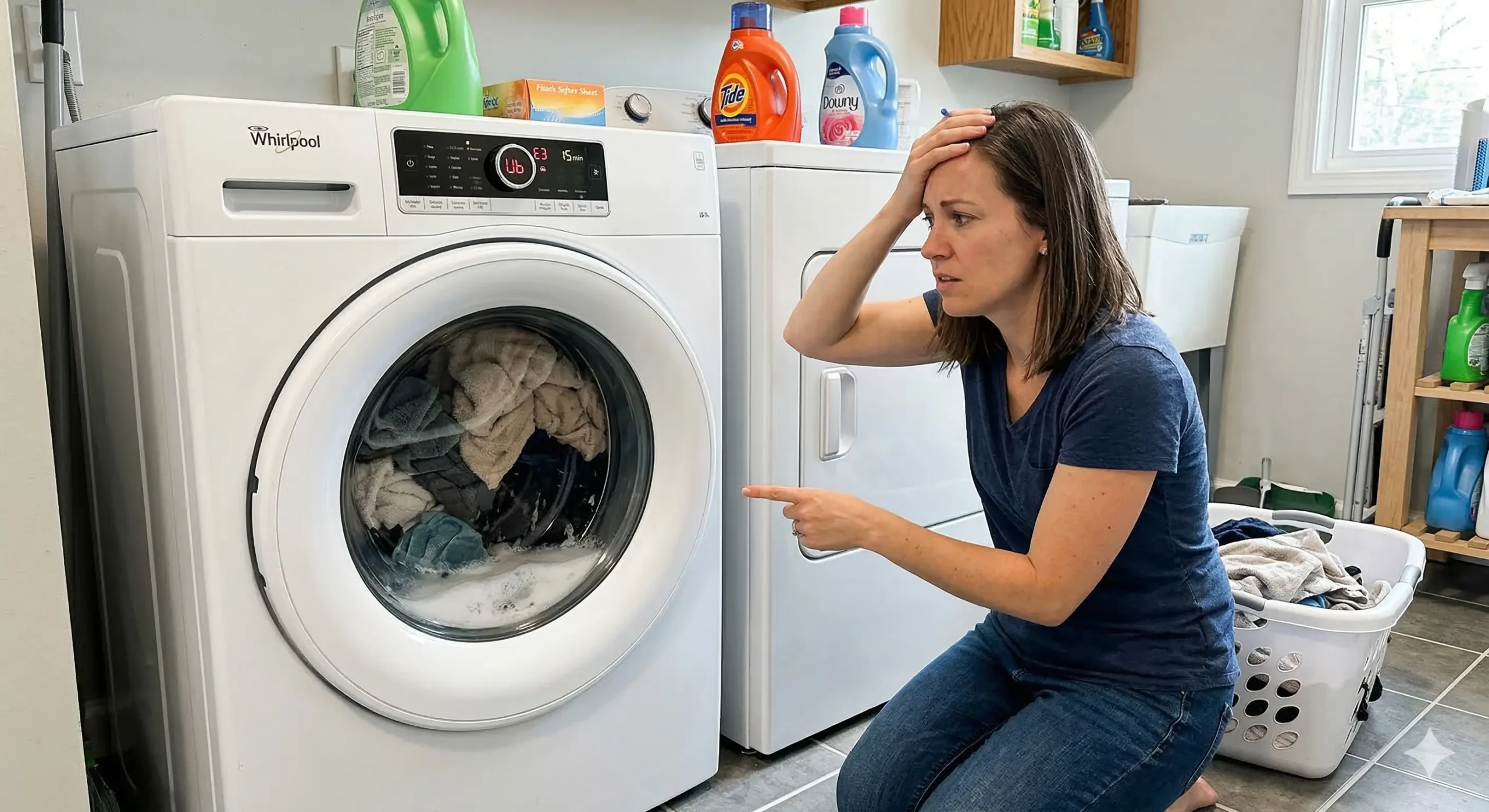
Persistent Error Codes That Don’t Clear After Reset
What It Means: Modern washers display alphanumeric error codes for specific faults. Examples include:
- F9E1 (Whirlpool): Long drain time
- E20/E21 (Electrolux/Frigidaire): Drain pump issue
- UE (LG): Unbalanced load
- SUD or F35 (various brands): Excessive suds or pressure sensor fault
DIY Step: Unplug the washer for 60 seconds to reset the control board. If the code returns when you restart the cycle, the underlying hardware fault remains.
Why You Shouldn’t Ignore It: Error codes are diagnostic tools, not suggestions. A persistent code means a component has failed or a sensor has detected an unsafe condition. Clearing the code without fixing the cause can damage the machine further.
Age Combined With Declining Performance
What It Means: If your washer is 10+ years old and experiencing repeated issues — slow fills, occasional leaks, noisy operation, longer cycle times — it may be signaling end-of-life fatigue.
How to Decide: Repair or Replace?
- Repair if: The issue is isolated (one failed pump, one broken belt) and the machine has otherwise performed well.
- Replace if: You’ve had three or more service calls in two years, the drum bearings are failing, or the control board is obsolete and expensive.
A trustworthy technician gives you an honest assessment. At AP1, we’ll tell you if a $150 repair gives you three more years or if that money is better applied toward a new machine. We have no incentive to push unnecessary repairs — our reputation depends on honest advice.
Call AP1 for Washer Repair in Indianapolis
Our technicians arrive with belts, pumps, motors, couplings, door locks, and seals for all major brands. We diagnose quickly, quote upfront, and get your laundry routine back on track — often the same day you call. From Broad Ripple to Greenwood, we cover Indianapolis and surrounding areas with same-day washer repair you can count on.