Skip to content

Baked goods that come out underdone, overdone, or unevenly cooked are usually a sign the oven isn’t holding the temperature it’s set to — not a sign of a bad recipe. Oven temperature problems are diagnosable with a simple test almost anyone can do at home, and the result determines whether the fix is a quick calibration or a component that needs replacing.
Quick Answer
Oven temperature problems are typically caused by a miscalibrated thermostat, a failing bake or broil element, a faulty temperature sensor, a worn door seal, or a malfunctioning igniter on gas ovens. An oven thermometer test is the most reliable way to confirm whether the oven is running hot, cold, or inconsistently before deciding on a fix.
Signs Your Oven Has a Temperature Problem
- Food consistently undercooked or overcooked at the correct setting and time
- Uneven baking, such as one side browning faster than the other
- Long preheat times or preheating that never seems to finish
- The oven light or indicator showing “preheated” before the interior is actually up to temperature
- Noticeable temperature swings during baking, visible in inconsistent results between batches
Step 1: Test With an Oven Thermometer
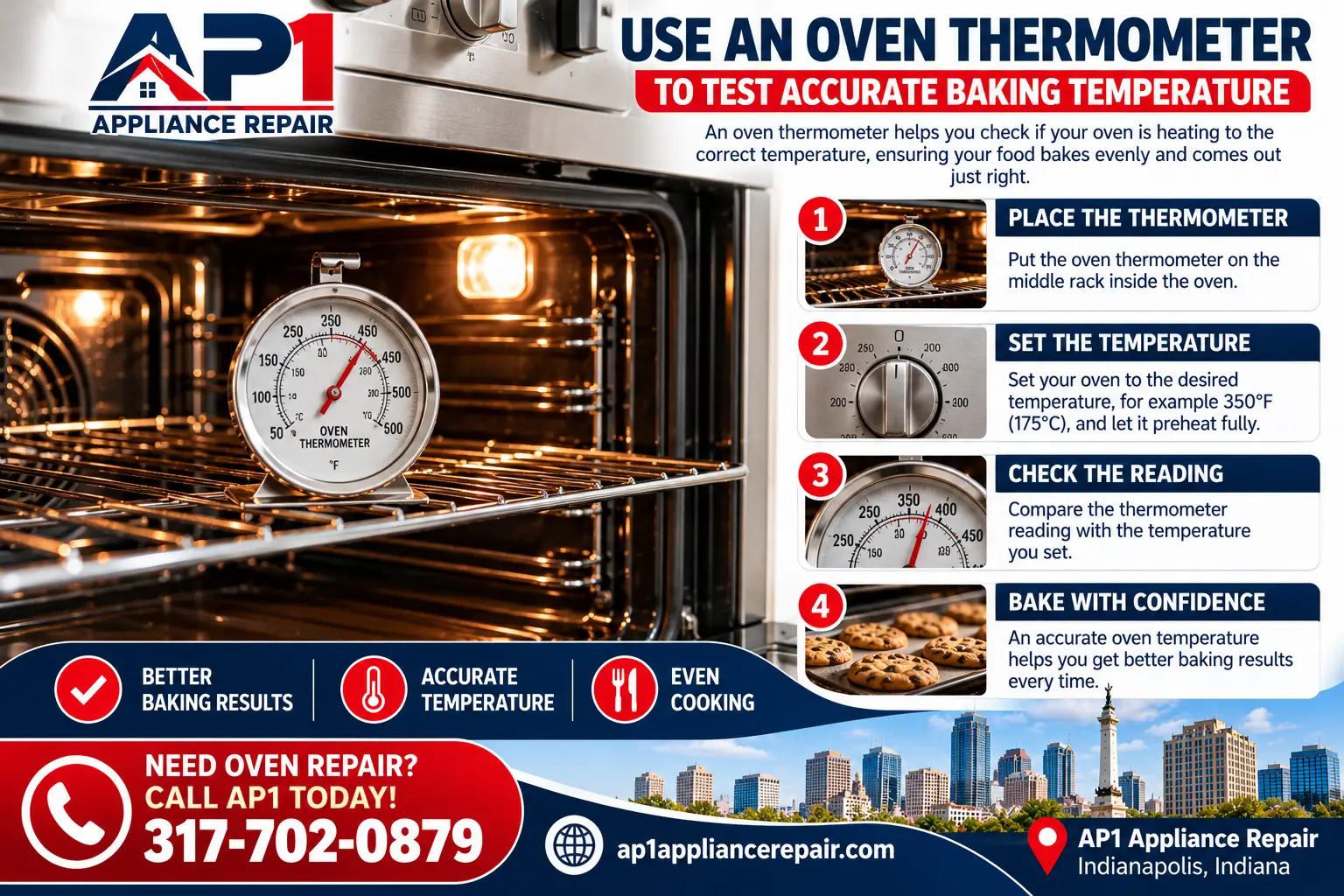
Before assuming any part is at fault, place an inexpensive oven thermometer in the center of the oven, set the oven to 350°F, and let it fully preheat plus run for 15–20 minutes. Check the thermometer reading against the set temperature. A consistent difference of more than about 25°F in either direction points to a real problem rather than normal fluctuation, since ovens naturally cycle a few degrees above and below the set point as the heating element turns on and off.
Common Causes of Oven Temperature Issues
Thermostat or Temperature Sensor Problems
Most modern ovens use a temperature sensor — a probe inside the cavity — rather than an old-style mechanical thermostat. If this sensor is reading incorrectly, drifted out of position, or has failed, the control board will cut off heat at the wrong point, leading to consistently high or low temperatures.
Failing Bake or Broil Element (Electric Ovens)
The bake element handles most cooking temperatures, while the broil element handles high, direct heat. A bake element that’s partially failed may still glow but not produce enough heat to reach the set temperature, leading to longer cook times and undercooked results even when the element looks fine visually.
Igniter Problems (Gas Ovens)
On gas ovens, a weak igniter can struggle to fully open the gas valve, resulting in a smaller flame and lower actual temperatures than what’s set. A visibly weak or slow-to-light igniter is often a sign it needs replacement.
Door Seal or Gasket Wear
A worn or damaged door gasket lets heat escape during baking, which can cause the oven to run cooler than the set temperature or cycle more frequently to compensate, leading to uneven results. Inspect the gasket for cracks, flattening, or gaps when the door is closed.
Miscalibration
Sometimes every component is functioning correctly, but the oven’s internal calibration is off by a consistent margin — for example, always running 20 degrees hot. Most ovens have a calibration setting accessible through the control panel that lets you adjust the set temperature to match actual performance.
How to Calibrate Your Oven
Many electric and gas ovens include a built-in calibration adjustment, usually accessed by pressing and holding specific buttons on the control panel (commonly Bake and Broil together, or a dedicated settings menu). The exact steps vary by brand and model, so check your owner’s manual for the specific sequence. Once in the calibration menu, you can typically adjust the offset up or down in small increments — often 5°F at a time — to correct a consistent temperature difference confirmed by your oven thermometer test.
What Homeowners Can Check Safely
- Testing actual temperature with an oven thermometer
- Inspecting the door gasket for visible wear or gaps
- Adjusting the built-in calibration setting if the oven runs consistently hot or cold
- Checking that the oven is level, since an uneven oven can affect how heat distributes
- Confirming vents inside the oven aren’t blocked by a baking sheet or foil
When DIY Should Stop
Replacing a heating element, temperature sensor, or igniter involves working inside the oven’s electrical or gas systems, often behind panels that require disconnecting power or gas supply first. These aren’t tasks to attempt without the right experience, particularly on gas ovens where an improperly reassembled igniter or valve creates a real safety risk.
When Professional Repair Makes Sense
If the calibration adjustment doesn’t resolve a confirmed temperature difference, or if the oven thermometer test shows temperature swings well beyond normal cycling, the issue is likely a failing sensor, element, or igniter rather than something adjustable through calibration. Indianapolis homeowners who’ve confirmed a real temperature discrepancy with a thermometer test, and ruled out an easy calibration fix, are typically looking at a component replacement that’s best handled by a technician.
An oven and stove repair professional can test the sensor, element, or igniter directly rather than relying on trial and error with calibration settings. AP1 Appliance Repair provides residential oven repair for homeowners in Indianapolis and the surrounding area.
FAQ
Use an oven thermometer placed in the center rack, set the oven to 350°F, and compare the reading after a full preheat plus 15–20 minutes of run time. A consistent gap of more than about 25°F points to a real issue.
If the oven is consistently off by a fixed amount, the built-in calibration setting can often correct it. If the temperature swings unpredictably or a part has failed, that typically requires professional repair.
A long preheat time can point to a weakening heating element, a failing igniter on gas models, or a temperature sensor that isn’t communicating accurately with the control board.
Yes. A gap in the door gasket lets heat escape, which can cause the oven to run cooler than the set temperature and cycle more often to compensate.
There’s no fixed schedule — calibration typically only needs adjustment if you’ve confirmed a consistent temperature discrepancy with a thermometer test, not as routine maintenance.
No. Gas oven components should only be tested or replaced by a qualified technician due to the risk of gas leaks.